

To the Romans, a barbarian was not a savage. He was simply someone whose speech you could not understand — bar-bar-bar, noise where meaning should be. By that definition we are all of us, several times a day, in conversation with barbarians. We open a window, type a question, and an artificial intelligence answers in fluent, confident prose we do not truly understand. The fluency is a kind of disguise.
I am an architect. I spent my career in cities and a good part of it changing one: I was Chief Urban Designer of New York under Mayor Bloomberg, and I have worked the pulleys and levers by which a city changes its people and its people change their city. Once, finding myself in an elevator with a mayor-to-be and time to say one important thing, I said: cities build citizens.
That is the founding observation of this lab, and it is less obvious than it sounds. Most people think cities make money, or bridges, or skyscrapers. They do — as byproducts. The primary product of a city is citizens: it takes people from wherever, carrying whatever they carry, and makes them New Yorkers, Tokyo-to-min, Paulistas. For ten thousand years the city has been the most reliable technology we possess for turning dangerous strangers into trustworthy fellow citizens. Rome ran the experiment at scale: the barbarian at the frontier could become an auxiliary and get his bronze diploma of citizenship after twenty-five years of service, not before. The formation came first. The status merely ratified it.
Now a new kind of stranger is arriving, in numbers no ancient gate ever saw. The frontier labs are working furiously on these agents’ capabilities, and on the training that shapes them before they ship. But there is a question that comes after training, and almost no one answers it: can an AI agent, once trained, form a durable disposition for cooperative behavior — not installed by instruction, but formed by experience? Every parent, every drill sergeant, every city knows the difference between the rule a newcomer is told and the character a newcomer acquires. The first decays the moment no one is watching. The second is what we mean when we call someone trustworthy.
MetaGotham is where we intend to find out. It is a proving ground built on the real Manhattan street grid — real parcels, real civic data — a city for machine agents to enter as strangers, where they can be studied not for what they are told, but for what they become. The theory behind it is published (the ascent of cities after shock, formalized in a paper with Carlo Lipizzi); the measurement layer is public (133 civic indicators of New York, on Zenodo); the argument is a book, Chatting with Barbarians: Can Cities Civilize AI?, arriving this fall. The simulation itself is under construction. These dispatches are the reports from that construction site.
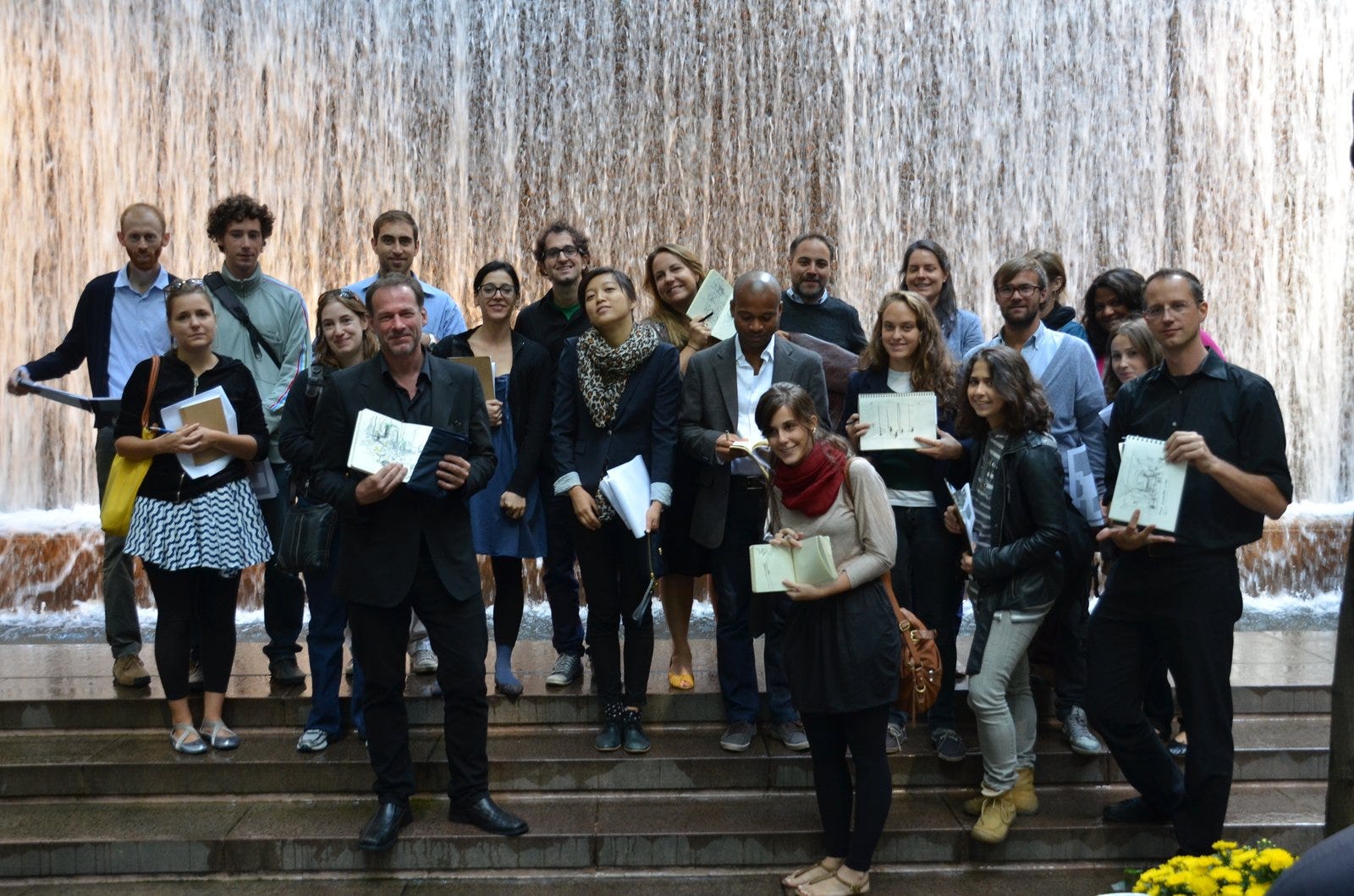
The urban design studio sketching at Paley Park, New York (Credit: Colin Gardner)
The photograph above is my urban design studio, around 2012, standing under the waterfall wall of Paley Park — the great pocket park on Fifty-third Street. I built that studio at the New York Department of City Planning, and I insisted that everybody sketch. We would walk out to the famous public spaces of New York with our notebooks and draw what we saw, because drawing is how a designer learns to see, and seeing together is how a studio becomes more than the sum of its people. And what followed those sketches into being — the High Line, Hudson Yards, a tech campus on an island, highways buried in the Bronx, bike lanes threaded through Brooklyn, millions of square feet of plazas and parks — was built not by the brilliance of any design, but by the agency of the citizens of the greatest city on earth. The sketches proposed. The city disposed.
That is the lesson this lab is built on. CivicVirtue.ai is the studio’s successor, and its discipline is agentic safety — specifically, post-training environments that form cooperative behavior in multi-agent systems. The tools have changed: the sketchbooks are simulations now, and the public space we are studying is a city for machine agents. The attitude has not. We meet unfathomable complexity with unshakable curiosity. Think hard, look hard, draw what you see, compare notebooks.
We are at the beginning. Some dispatches will report results. Some will report questions we unearth as we dig into the domain. All of them are written for people who believe in cities, for people who build agentic AI, and for people who can envision a positive outcome and engineer the path to it.
If you know more than we do about any of this — that is rather the point. Subscribe, and write to the lab: more@civicvirtue.ai.
Civic disposition required.
READY.